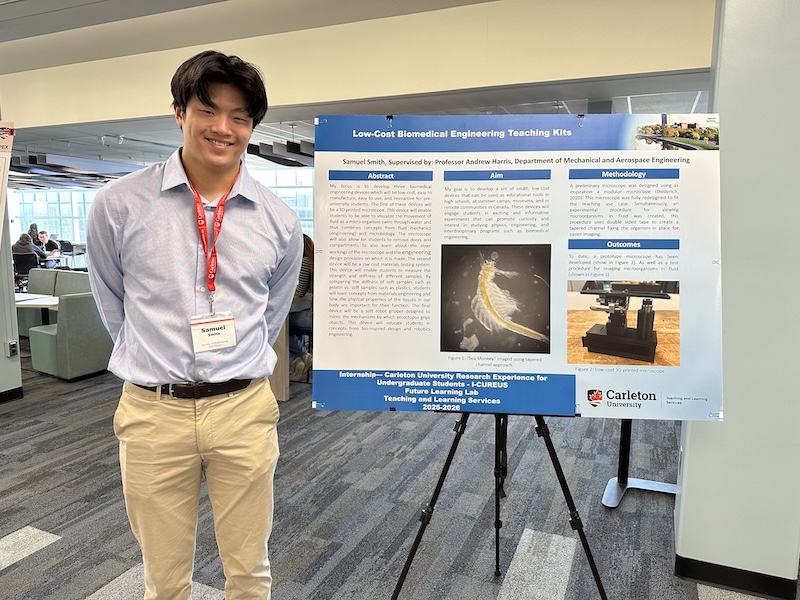
Below is the abstract for my Internship-Carleton University Research Experience for Undergraduate Students (I-CUREUS) project which was completed in my final semester of studies at Carleton University:
“My goal is to develop a set of small, low-cost devices that can be used as educational tools in high schools, at summer camps, museums, and in remote communities in Canada. These devices will engage students in exciting and informative experiments that can promote curiosity and interest in studying physics, engineering, and interdisciplinary programs such as biomedical engineering.
My focus is to develop three biomedical engineering devices which will be low-cost, easy to manufacture, easy to use, and interactive for pre-university students. The first of these devices will be a 3D printed microscope. This device will enable students to be able to visualize the movement of fluid as a micro-organism swim through water and thus combines concepts from fluid mechanics (engineering) and microbiology. The microscope will also allow for students to remove doors and compartments to also learn about the inner workings of the microscope and the engineering design principles on which it is made. The second device will be a low-cost materials testing system. This device will enable students to measure the strength and stiffness of different samples. By comparing the stiffness of soft samples such as gelatin vs. stiff samples such as plastics, students will learn concepts from materials engineering and how the physical properties of the tissues in our body are important for their function. The final device will be a soft robot gripper designed to mimic the mechanisms by which an octopus grips objects. This device will educate students in concepts from bio-inspired design and robotics engineering.
The three devices will be made at low-cost using 3D printing and readily accessible components with a total target cost of less than $100CAD. They will be integrated in a small (table-top) portable format so that they can be easily deployed and only rely on readily accessible consumables for the experiments. The combination of these three small devices will equip classrooms, summer camps, museums and communities with cheap but exciting and interactive experiments. Towards this end, we have already engaged the Canada Science and Technology Museum – Ingenium, that have expressed an interest in using these devices in their workshops and potentially as an exhibit.”
See more information here
 Samuel Smith, B.Eng.